Self-hosted family planner — tasks, calendars, shopping, meals, budget.
Your data stays on your server. No subscriptions. No tracking. No cloud lock-in.
---
Oikos is a self-hosted family organizer for 2–6 people. Tasks, calendars, shopping lists, meal plans, budget tracking, notes, and contacts — all running on your own server inside a single Docker container. No cloud dependency, no telemetry, no data leaves your network.
Built with Express.js, SQLite (optionally encrypted via SQLCipher), and vanilla JavaScript — no frontend framework, no build step. Works offline as a PWA on phones and tablets.
Oikos is **not** a SaaS product, not a team collaboration tool, and not designed for public multi-tenant use. It is a private tool for one family on one server.
---
## Screenshots
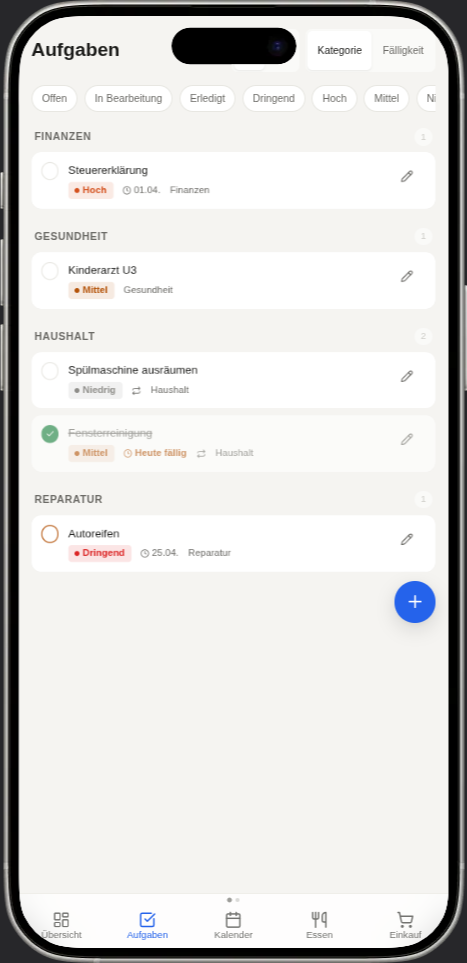
Tasks
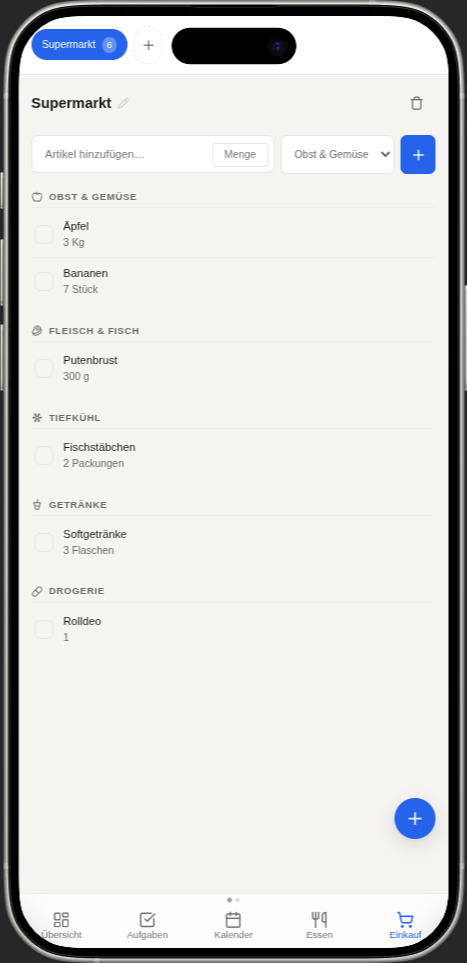
Shopping
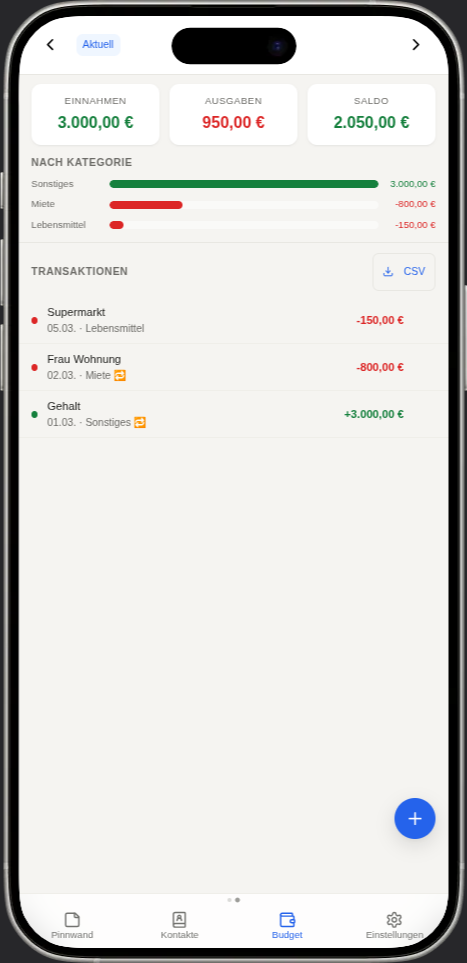
Budget
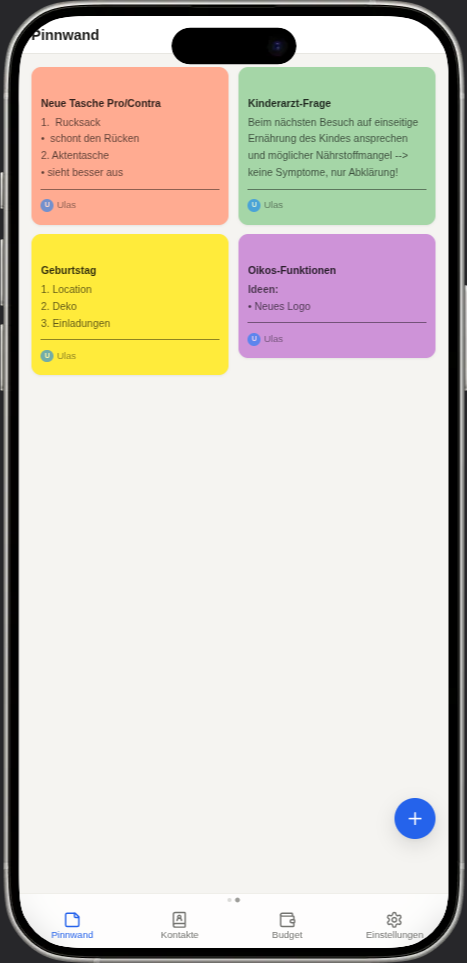
Notes
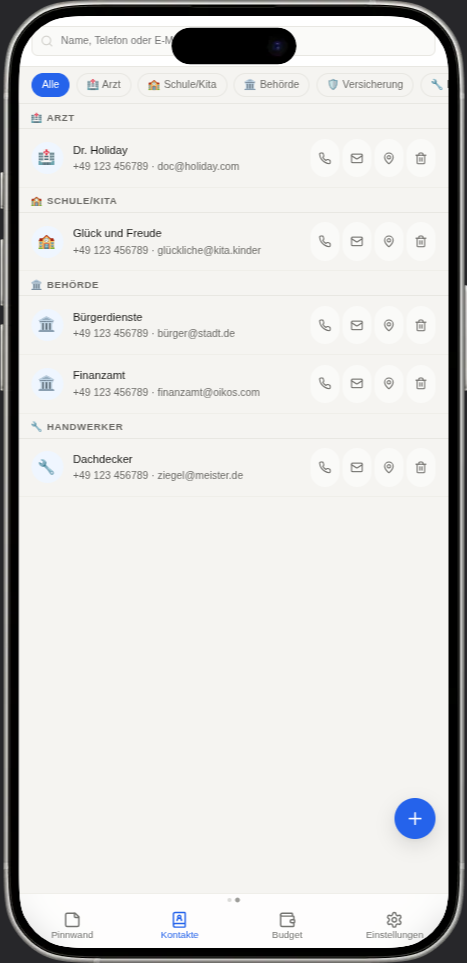
Contacts
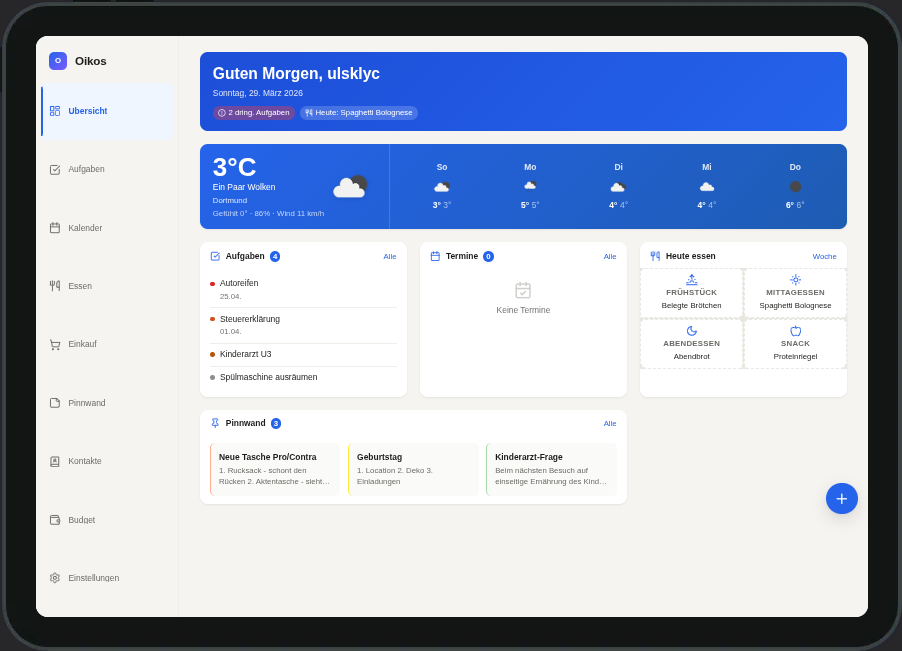
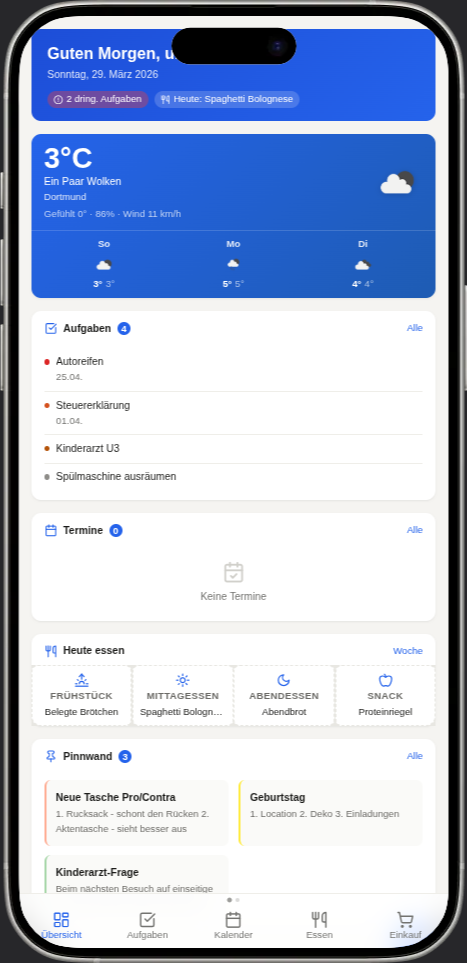
Dashboard — Mobile
Screenshots adapt to your GitHub theme — switch between light and dark mode to see both variants.
---
## Features
| | Module | What it does | Highlights |
|---|---|---|---|
| 📋 | **Dashboard** | At-a-glance overview of your family's day | Weather widget · upcoming events · urgent tasks · today's meals · pinned notes |
| ✅ | **Tasks** | Shared to-do lists with accountability | List + Kanban views · subtasks · recurring tasks (RRULE) · swipe gestures · priority levels |
| 🛒 | **Shopping** | Collaborative grocery lists | Multiple lists · aisle-grouped categories · auto-import from meal plan |
| 🍽️ | **Meals** | Weekly meal planning with ingredients | Week view (Mon–Sun) · ingredient management · one-click export to shopping list |
| 📅 | **Calendar** | Family calendar with external sync | Month/week/day/agenda views · Google Calendar & Apple iCloud two-way sync |
| 📌 | **Notes** | Shared family pinboard | Colored sticky notes · pinning · lightweight Markdown (bold, italic, lists) |
| 👥 | **Contacts** | Important family contacts | Category filters · tap-to-call · tap-to-email · map links for addresses |
| 💰 | **Budget** | Income & expense tracking | Category breakdown · month-over-month comparison · CSV export |
| ⚙️ | **Settings** | User & sync management | Password changes · calendar sync config · family member admin |
---
## Tech Stack
| Layer | Technology |
|---|---|
| **Server** | Node.js ≥ 20 · Express · better-sqlite3 · bcrypt · Helmet |
| **Database** | SQLite with optional SQLCipher encryption (AES-256) |
| **Frontend** | Vanilla JavaScript ES modules — no framework, no build step. Web Components (`oikos-*`). Lucide Icons (self-hosted SVG sprite) |
| **Auth** | Session-based · httpOnly cookies · CSRF double-submit · express-session |
| **Deployment** | Docker + Docker Compose · Nginx reverse proxy · Let's Encrypt SSL |
| **Integrations** | Google Calendar API v3 (OAuth 2.0) · Apple iCloud CalDAV (tsdav) · OpenWeatherMap |
---
## Quick Start
**Prerequisites:** Docker + Docker Compose on a Linux server.
### 1. Clone
```bash
git clone https://github.com/ulsklyc/oikos.git
cd oikos
```
### 2. Configure
```bash
cp .env.example .env
```
Edit `.env` and set the two required variables:
```env
SESSION_SECRET=your-random-string-at-least-32-chars
DB_ENCRYPTION_KEY=your-sqlcipher-aes256-key
```
### 3. Start
```bash
docker compose up -d
```
First build takes 2–3 minutes (compiles SQLCipher against better-sqlite3).
### 4. Create admin account
```bash
docker compose exec oikos node setup.js
```
Interactive script — sets up username, display name, and password. This admin can create additional family members from the settings page.
### 5. Open
Navigate to `http://localhost:3000` — or your configured domain after Nginx setup.
> **Nginx:** See [`nginx.conf.example`](nginx.conf.example) for a production-ready config. If you use [Nginx Proxy Manager](https://nginxproxymanager.com), paste the contents into the "Advanced" tab. Make sure `X-Forwarded-Proto` is set so session cookies work correctly in production.
---
Configuration
### Required
| Variable | Description |
|---|---|
| `SESSION_SECRET` | Random string ≥ 32 characters for session signing |
| `DB_ENCRYPTION_KEY` | SQLCipher AES-256 key. Leave empty to disable encryption |
### Optional
| Variable | Default | Description |
|---|---|---|
| `PORT` | `3000` | Server port |
| `NODE_ENV` | `development` | Set to `production` for deployment |
| `DB_PATH` | `./oikos.db` | Path to SQLite database file |
| `SYNC_INTERVAL_MINUTES` | `15` | Automatic calendar sync interval |
| `RATE_LIMIT_MAX_ATTEMPTS` | `5` | Max login attempts per minute per IP |
### Weather Widget
Register a free API key at [openweathermap.org](https://openweathermap.org/api):
| Variable | Default | Description |
|---|---|---|
| `OPENWEATHER_API_KEY` | — | Your API key |
| `OPENWEATHER_CITY` | `Berlin` | City name |
| `OPENWEATHER_UNITS` | `metric` | `metric` (°C) or `imperial` (°F) |
| `OPENWEATHER_LANG` | `de` | Language code |
### Integrations
| Variable | Description |
|---|---|
| `GOOGLE_CLIENT_ID` | Google OAuth 2.0 Client ID |
| `GOOGLE_CLIENT_SECRET` | Google OAuth 2.0 Client Secret |
| `GOOGLE_REDIRECT_URI` | `https://your-domain/api/v1/calendar/google/callback` |
| `APPLE_CALDAV_URL` | `https://caldav.icloud.com` |
| `APPLE_USERNAME` | Your Apple ID email |
| `APPLE_APP_SPECIFIC_PASSWORD` | App-specific password from Apple ID settings |
Full template: [`.env.example`](.env.example)
---
Calendar Sync
Oikos syncs bidirectionally with Google Calendar and Apple iCloud. External events are visually distinguished in the UI. On conflict, the external source wins.
### Google Calendar
1. Create a project at [console.cloud.google.com](https://console.cloud.google.com)
2. Enable the **Google Calendar API**
3. Create an **OAuth 2.0 Client ID** (type: Web application)
4. Add your redirect URI:
```
https://your-domain.com/api/v1/calendar/google/callback
```
5. Add credentials to `.env`:
```env
GOOGLE_CLIENT_ID=...
GOOGLE_CLIENT_SECRET=...
GOOGLE_REDIRECT_URI=https://your-domain.com/api/v1/calendar/google/callback
```
6. Restart: `docker compose up -d`
7. In Oikos: **Settings → Calendar Sync → Connect Google**
**Sync behavior:** Initial sync pulls events from 3 months ago to 12 months ahead. Subsequent syncs use Google's `syncToken` for incremental updates. Local events push to Google automatically. Conflicts: Google wins on simultaneous edits.
### Apple Calendar (iCloud CalDAV)
1. Go to [appleid.apple.com](https://appleid.apple.com) → Sign-In and Security → App-Specific Passwords
2. Generate a new password for "Oikos"
3. Add to `.env`:
```env
APPLE_CALDAV_URL=https://caldav.icloud.com
APPLE_USERNAME=your@apple-id.com
APPLE_APP_SPECIFIC_PASSWORD=xxxx-xxxx-xxxx-xxxx
```
4. Restart: `docker compose up -d`
The sync button appears automatically in Settings.
---
## Security
Oikos is designed to run on a private server behind SSL. No public endpoints exist except the login page.
- **Sessions** — `httpOnly`, `SameSite=Strict`, `Secure` in production, 7-day TTL
- **CSRF** — Double-submit cookie pattern on all state-changing requests
- **Passwords** — bcrypt with cost factor 12
- **Rate limiting** — 5 login attempts/min, 300 API requests/min per IP
- **Headers** — Strict Content Security Policy via Helmet (`self`-only)
- **Encryption** — Optional SQLCipher AES-256 database encryption at rest
- **Access control** — No API endpoint accessible without session auth (except `/api/v1/auth/login`)
- **No public registration** — Only admins can create user accounts
---
Development
### Local Setup
```bash
npm install
cp .env.example .env
# Set SESSION_SECRET — skip DB_ENCRYPTION_KEY (no SQLCipher needed locally)
npm run dev # Starts server with --watch (auto-reload)
```
### Tests
```bash
npm test # 146 tests across 7 suites
```
Tests use Node.js built-in test runner with `--experimental-sqlite` for in-memory SQLite. No running server required.
### Architecture
```
server/
index.js # Express entry, middleware, static serving
db.js # SQLite connection, migration runner
auth.js # Session auth + user management routes
routes/ # One file per module
services/ # Calendar sync, recurrence engine
public/
index.html # SPA shell
router.js # History API router (~50 lines)
api.js # Fetch wrapper with auth + CSRF
styles/ # Design tokens, reset, layout, per-module CSS
components/ # Web Components (oikos-* prefix)
pages/ # Page modules with render() export
sw.js # Service worker
```
**Request flow:** Client → Express static or `/api/v1/*` → session auth middleware → route handler → better-sqlite3 (sync) → JSON response.
**Database migrations** run automatically on startup. Each migration is an idempotent SQL block in `server/db.js`. Append new migrations — never modify existing ones.
---
Backup & Restore
### Backup
```bash
docker run --rm \
-v oikos_oikos_data:/data \
-v $(pwd):/backup \
alpine tar czf /backup/oikos-backup-$(date +%Y%m%d).tar.gz /data
```
### Restore
```bash
docker compose down
docker run --rm \
-v oikos_oikos_data:/data \
-v $(pwd):/backup \
alpine tar xzf /backup/oikos-backup-YYYYMMDD.tar.gz -C /
docker compose up -d
```
Database migrations run automatically on startup. Data in the `oikos_data` volume is preserved across container rebuilds.
---